Monday, June 9, 2008

Playfish Dominates the Social Gaming Top Ten

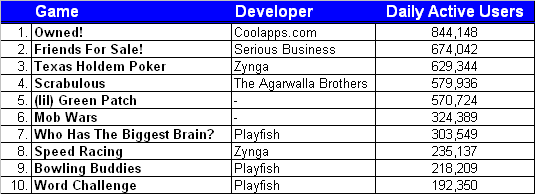
Today, I'm introducing The Social Gaming Chart, a biweekly compilation of the top ten games on the social networks. For now, I'm only covering games on Facebook. Once we see significant traction and easily available metrics for the other socnets, I'll start including them.

The Social Gaming Chart
SocialGamingChartJune1
Note: data was compiled on Thursday, June 5, 2008.

My Take

The social games space is growing.
Since I compiled the first social gaming chart just over three months ago, the amount of daily active users of the top ten Facebook games has increased from 2,740,002 to 4,628,872. That's an increase of 69% in three months.

The social games space is changing rapidly. Only three games that were in the top ten three months ago remain: Scrabulous, Texas Holdem Poker, and Speed Racing. All three have fallen in rank, but only Scrabulous lost users. Texas Holdem Poker and Speed Racing gained users. Meanwhile, new companies and game types have replaced and surpassed the old crowd.

The company to watch.
Playfish is proving that a company can consistently crank out hit social games. So far, they've released three games (Who's Got the Biggest Brain, Word Challenge, and Bowling Buddies) and each game has reached the top ten. Without cross-promotion!

They've discovered a winning formula: integrate a friends-oriented leaderboard into well-designed single-player flash game based on a proven casual game concept. However, as I suggested in a previous post, I think that games based on this formula will have a shorter shelf-life than games that have direct interaction with your friends(such as Scrabulous and Texas Holdem). Simple single-player games tend to get boring quick. Having said that, people play solitaire for their entire lives, so who knows. But then again, you don't play solitaire with friends.

Regardless, I think Playfish will continue to be successful, pumping out a string of hit games based on this formula. No other company is consistently creating polished, high-quality, flash games for the Facebook audience. I'm interested to see when they'll start releasing multiplayer games, which have more difficult technical requirements. But I doubt they're in any rush.

Thursday, June 5, 2008

Does Cross-Promoting a Game Work?


Did you know the makers of Scrabulous also had a Chess app?

Yep. It's called Chess Pro and has about 14,000 daily actives users as of today. Now 14,000 DAU isn't bad at all unless you compare it to Scrabulous' 500k+ daily active users.

Here's the thing. Scrabulous ran a link on Scrabulous for about 2-4 weeks (possibly more), saying something like "Try Chess Pro, the new game from the makers of Scrabulous!". It was fairly prominently placed under the Scrabulous playing area. Nothing egregious, Rajat and Jayant are very conservative with their promotional activity, always opting for the understated, classy aesthetic.

Now, how many installs do you think an app cross-promoted from a top ten app would acquire?
You'd probably say "a helluva lot". But of course, you're wrong. As of today, Chess Pro has ~111,000 installs. For perspective, Chess Pro doesn't even rank in the top 1000 for number of installs.

Only 20% of the daily audience of Scrabulous even bothered to install Chess Pro, and arguably less since Chess Pro grew some on its own.

So in this case, I'd suggest that the cross-promotion didn't work.

So how do you effectively cross-promote a game?

By genre. Make sure that players of one game will actually want to play the other game. For instance, there's a significant overlap of users between Scrabulous and Scramble because they are both word games. Yes, it's shocking. People who like to play one word game also like to play another word game. However, they are not necessarily going to want to play Chess. Or Speed Racing.

By demographic. Courtesy of the casual game industry, we know that women like card, puzzle, word, and quiz games. And men like action and strategy games. Obviously there are exceptions, but as a general rule, these stereotypes hold. Use them to your advantage.

And even still, there's no guarantees that the new game will succeed. As Mark Pincus, CEO of Zynga, pointed out at Interplay, (and I paraphrase), no matter how much traffic you sent a game, it won't succeed unless it's good. By good, I think he means viral, since there are a lot of good games with paltry traffic.

The core problem in the social games industry is that making a viral game that's also engaging is really hard. No one is doing it consistently (except Playfish, and even their current model of affixing a light social component to one-player flash games will stale eventually.)

The fact is, if you can't consistently make viral games that are also engaging, then it doesn't matter if you cross-promote from Scrabulous, you're not going to grow your network.

Monday, June 2, 2008

Interplay Conference for Free! (on video)

Ustream.tv has video of all the conference panels(even the one I moderated on managing a virtual economy). Check it out and see what you missed.

Having said that, the real value of a conference is meeting the people in your industry. You can't that on video.

Tuesday, May 27, 2008

Takeaways from the Interplay Social Gaming Conference

Since I didn't take notes, here are some of the things still rattling around my brain days later:

Channels Panel: Zynga and SGN suggested that they might be working on linking their networks. The basic idea is that they would sell clicks to companies wanting to get their properties in front of the gaming audience and the network that served the game link that was clicked through would get the credit. I know both these companies have greater ambitions than to be ad, *cough*, I mean, game networks, and this detente suggests that they may be differentiating toward different aspects of social gaming. Or not. :)

Platforms Panel: Jessica Alter of Bebo indicated that AOL Instant Messenger would be integrated directly into the Bebo platform. The AOL-Bebo acquisition just closed, but Jessica indicated that this was an immediate priority for the AOL-Bebo team. Despite my general bearishness on real-time games in the near future, I think Bebo may soon offer the best opportunity for real-time games. One immediate beneficiary should by the team leading the QQ Games US division, who already have a close relationship with AOL and would benefit immensely from the social network traffic (that is if people can get over having to download the QQ client).

VC Panel: Jeremy Liew, Lightspeed Venture Partners believes that there is an opportunity for a social games publisher to emerge much in the way that EA did back at the birth of computer games. His thesis rests on the presupposition that a publisher can create/acquire a succession of hit games. It's a risky proposition (especially for a VC) considering that so far, no publisher has seen more than 1-2 hit games in their portfolio, despite hundreds of games being launched on Facebook. Meanwhile, Naval Ravikant, Hitforge felt that Facebook was no place for venture-backed companies, since the revenue wasn't there yet, but it was great for lifestyle businesses. Accel's Ping Li is looking at gaming infrastructure plays, which strikes me as the typical venture approach, i.e. avoiding content risk and focusing on platform plays.

Advertising Panel: Sadly, I missed most of it due to , but there was an indication that branded virtual items were already becoming a big source of revenue.

Virtual Economy Panel: I heard the moderator was amazing, some guy name Bret. Extremely handsome and wow, was he funny. Okay, it was me, I was the moderator. The panel agreed that if you don't THROUGHLY think through your economy before you launch your game, you will be screwed. Siqi Chen, CEO of Serious Business indicated that he believes the slowing growth of Friends For Sale is due to inflation - simply put, it's becoming too expensive for newer players to buy anyone. I think it's a very reasonable assumption, and shows how important economy is to the overall health of a game. Fraud was also a huge issue for all the panelists, Siqi revealed that 3 of his 12 employees did nothing but handle fraud issues. That's 25% of the headcount for all you kids out there making your business plans.

Siqi also made the claim that just being on a panel with him would get us laid. I'm not going to say whether it's true or not, you'll have to judge by the title of this Facebook group.

Developer Analytics and Playfish both offered excellent presentations which I will link to once they get them posted. And I'll possibly comment on them.

Friday, May 23, 2008

Why I Love Being in the Games Industry.

Normally, I hate writing soft posts, you know those posts where the author talks about how much they love risotto, when all I really care about is their analysis of the social games industry. That is why you all subscribe to my blog, after all.

Well, there'll be no analysis today, nor talk about the finer aspects of risotto (I know you're disappointed). This is just a love letter to the social games industry.

If you give it a moment of thought, to spend your adult life creating games seems pretty trivial when compared to say curing cancer. It probably is. But it's a helluva lot more fun. Oncologists may feel free to disagree.

But honestly, would you really want to live in a world without games? I know people who never play games. I don't like them. They're boring. Their imagination has been drained. They're afraid to say fuck at work. You can often find them in the telecom industry (or so I've heard).

One of the sad truths about being in the games industry is that many of us work so hard that we don't get to play games. I've never played World of Warcraft. I'm terrified of it. I know that if I started playing it...well, let's just say that I once was so addicted to Civilization 2 that I had to destroy the installation CD. Sadly, I bought a new copy the next afternoon. Even now, if someone even mentions Persians I start to...dear god, I just gave myself a Civ craving.

Fortunately, people in the games industry have gigantic stores of imagination, enough to carry us through droughts where we can't find time to play. And guess what, imaginative people are fucking awesome. They're smart, friendly, open, funny, cool, gracious, curious...the person that deep down we all want to be, but we're afraid we're not.

Yesterday, I got to spend my day with two hundred of these amazing, imaginative people at the first ever social gaming conference, Interplay. It was a privilege, and I thank every single one of you for making our nascent industry feel like a family.

Love,

BT

Wednesday, May 7, 2008

Do Gaming Networks Work?: Reach and Engagement Numbers for Zynga and SGN

As anyone who reads this blog knows, back in February Zynga and SGN opened up their game networks to 3rd party developers. For the moment, these networks are essentially link exchanges facilitated through game bars embedded on the 3rd party developer's canvas page.

Fortunately, these embedded game bars resolve to unique addresses. For Zygna, it's zbar.zynga.com, and for SGN, it's sgnbar.com. You'll note the graphs below list zynga.com, not zbar.zynga.com, that's because Compete doesn't provide breakdowns on subdomains. However, according to Quantcast, ~99% of traffic to zynga.com is to the zbar.zygna.com subdomain, so for my purposes, zynga.com is the domain of interest.

First let's look at monthly unique visitors:


When looking at the graph, it's important to note that most 3rd party games didn't come onto the network until March. Keeping that in mind, April is the most telling month, Zynga increased their monthly uniques by 200,000, while SGN, increased by 300,000.

How much of this traffic increase can be attributed to the 3rd party games, and not growth in the game network's core properties? In SGN's case, all of it, their core properties have been in steady decline since December. I suspect, it's helped Zynga, as well, since growth in their core games has flat-lined, as well.

So it's seems that when in comes to acquiring new users, the game network strategy has worked very well for the game networks.

One interesting note, SGN claims 1 million daily active users, which is the aggregate number from all their core game apps. However, if you look at the monthly uniques count, it's around 425,000 for the ENTIRE network, including 3rd party developers. That suggests that there's an immense amount of user overlap between SGN's core game properties. If the Compete data is accurate, then it's unlikely that SGN has more than 400,000 UNIQUE daily active users across their core properties, with the caveat that their flagship game Warbook oddly does not have the gamebar embedded in it, so its visitors are not included in the graph above. However, Warbook has less than 40,000 DAU, most of whom probably play other games in the SGN network and are thus counted.

According to Adonomics, Zynga has about 2 million DAU. However, their monthly unique visitor count is 800,000. Again, suggesting that more than half of that audience plays more than one game and is counts multiple times in Adonomics aggregate number.

Having just pointed out the massive overlap, I'd like to point out that if we DID NOT see at least a 50% overlap of users between games, it would be much more troubling. It would imply that most users do not play more than one game in a game network, and therefore a game network would offer no value. So, clearly the games network strategy is working.

UPDATE: After being reminded by Joe G. of Flixster that Compete only tracks U.S. visitors, it occurred to me that the gap between DAU and monthly unique visitors could be a result of a large number of Zynga and SGN's users being located outside the U.S. That would hardly be surprisingly, since Facebook (which provides the large bulk of the traffic) has an enormous international audience.

With that in mind, now I'm concerned that we might not be seeing the overlap I identified above, which WOULD suggest that game networks are effective at sending users to other games on their network. Right now, I can't answer this definitively one way or the other because of lack of the necessary data. Sigh.

Now that we have the monthly unique visitor count, we can compare SGN and Zynga to destination game sites that do not have social network integration. Which I will have to do tomorrow, as Compete's web server is currently down. Drats.

Now, let's look at pageviews, one of the standard metrics of engagement:


Again, April is the interesting month here, since it's the most recent data and it's the month where both networks had fully launched. In April, Zynga's pageviews increased slightly, but SGN's pageviews took a 25% nosedive. Why? I have no idea. Speculate in the comments.

Finally, my favorite metric, average length of visit. As a measure of engagement, I find this metric to be most accurate when comparing different types of games.


Both SGN and Zynga experienced a severe drop in engagement from March to April. This drop is troubling. Both networks added 20+ games between late February and April and engagement drops. You would think it would be the opposite, that engagement would increase, as users spend time trying out the new games. But they spend less time, suggesting that either they got bored fast of the new games, or they didn't even try the new games. Which I think may have happened, since both networks operate as link exchanges that offer more presence to games that send them traffic. As a result, only games with significant traffic independent of the network got heavy placement on the gamebar. I doubt many small games got a significant boost in traffic from participation in either game network. Looking at three games on the Zynga network: Perfect Warrior, Downman, and PuzzleBee; none show any noticeable bump in growth during the last three months. In fact, PuzzleBee saw a slight decline.

I think that unless Zynga and SGN become much more generous in promoting small non-viral games, both networks will not see any boost in engagement.

The fact is, many of these small games are highly engaging, but lack virality. They need a network to promote them in order to succeed. The 1:1 economics of link exchanges will not solve this problem.

It appears for the moment, that game networks benefit the network, far more than they benefit the independent developers. I hope that will change.

Predictions

My prediction is that we'll see growth plateau quickly for both game networks, topping out by July (barring acquisitions, and expansion into new markets which will mask their stagnation in the maturing Facebook market).

My other prediction is that we're going to see a lot more acquisitions designed to mask stagnant growth.

My other other prediction is that Texas Holdem Poker will dominates all social networks.